
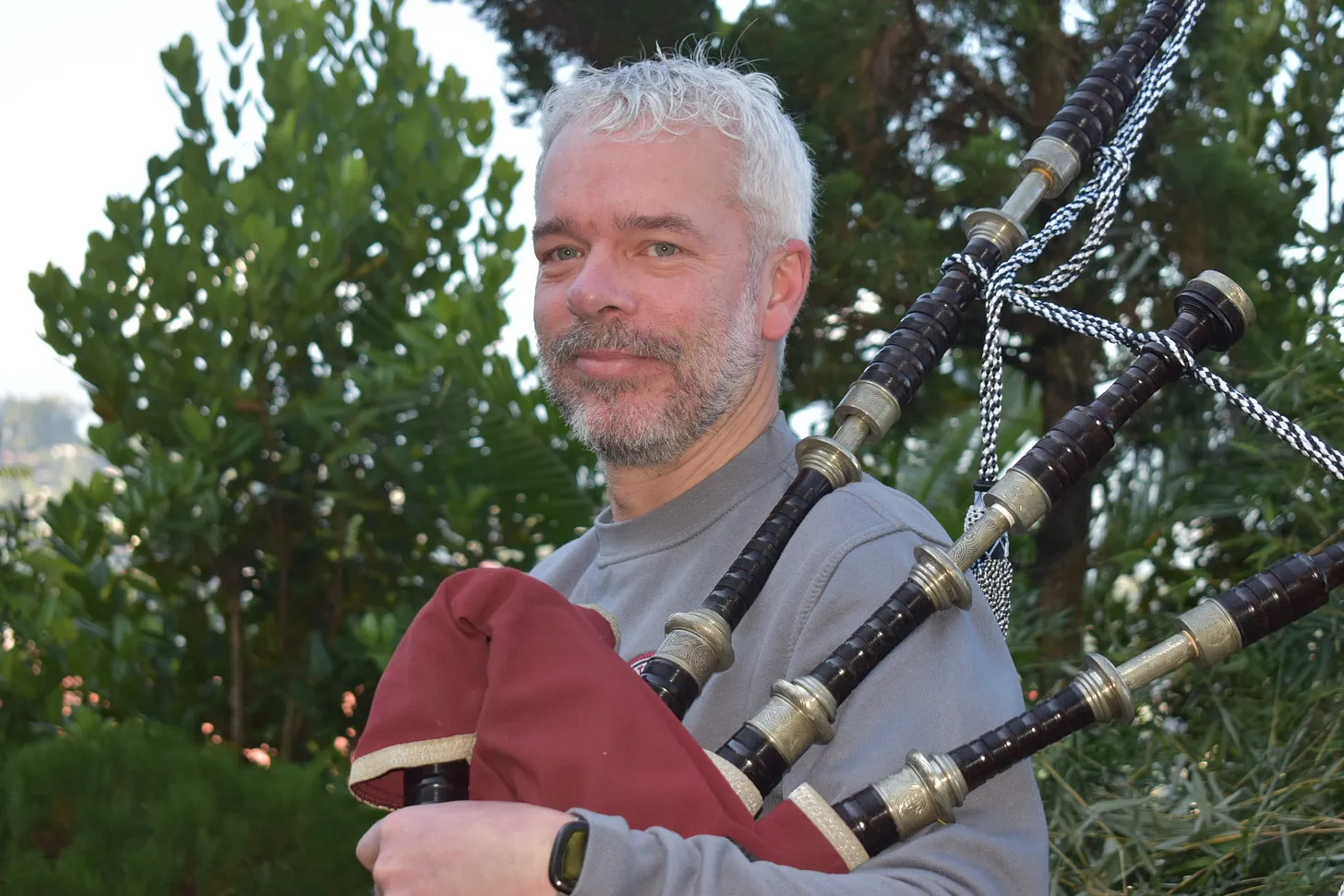
Pipe Major Lee Moore of the Scottish Schools Pipes & Drums Trust is exploring a Highland–Himalayan school twinning, his Kalimpong visit forging a cultural bridge through the bagpipe
Read more: WHERE HILLS MEET HIGHLANDSLong before Scotland’s schools formally brought piping into the classroom, students in Kalimpong, a hill town in West Bengal, India were already marching to the skirl of the bagpipe. For Pipe Major Lee Moore of the Scottish Schools Pipes & Drums Trust (SSPDT), the history is striking. “It is remarkable,” he says, “that pipe bands were being taught here even before they appeared in Scottish state schools.” Moore is the full-time Piping Instructor at Preston Lodge High School supported by SSPDT.
The bagpipe was introduced to Kalimpong by Scottish missionaries who settled in the region from the late 1800s onward. When the Church of Scotland and the Scottish Universities’ Mission began their education and outreach work in the Eastern Himalayas, they brought with them not only their religious and academic traditions but also elements of Scottish culture, including the Highland bagpipe.
Moore has spent the past week visiting Kumudini Homes, Dr Graham’s Homes, Pranami Balika Vidhya Mandir, and Scottish Universities’ Mission Institution (SUMI), schools where the pipes are played with a confidence and enthusiasm that surprise even seasoned Scottish tutors. “The energy here is incredible,” he says. “The bagpipe is not an easy instrument. There is the physicality of blowing, coordinating fingers, drones… yet the children take it on with real commitment.”
The visit to Kalimpong began through a loose link: a friend of his employer had ties to SUMI and suggested exploring a possible twinning opportunity. What Moore found on arrival surprised him. “There are so many schools here learning the pipes,” he says. “And what’s fascinating is the performance culture. In Scotland, during competitions we stand completely still. Focus is entirely on sound. Here, performance includes choreography and movement. It is a different tradition, and genuinely interesting to watch.”
He has also observed technical differences. Most local players have learned from recordings rather than formal tuition, naturally leading to variations in fingering and execution. “It is admirable how far they have come with so little guidance,” he observes, impressed by their determination. “They have worked incredibly hard to replicate what they hear.”
Where he sees room for support is in technique and equipment. Many schools use Indian-made pipes which, while improving, remain difficult to play at high precision. “Better instruments could make a big difference,” Moore notes. “In Scotland, even a basic beginner’s set, often partly machine-finished, partly handcrafted, starts around a thousand pounds.”
Though Moore has lived in Scotland for most of his adult life, he grew up in Northern Ireland, where piping is “almost like a third religion.” His father, uncle, and aunt all played in bands, and he learned young. Moving to Scotland to immerse himself in the piping world was, for him, the natural next step.
Moore joined SSPDT about 15 years ago, when bagpipe tuition in Scotland’s state sector was almost non-existent. “At that time, if you were in a fee-paying school, yes, you could learn the pipes,” he explains. “But in state schools you could not. You could learn guitar or piano because those were government-supported.”
The Irishman hopes his visit will be the start of deeper ties between Scottish and Kalimpong schools. “At the moment, we are just building relationships, seeing how pupils might visit one another, how tutors might share knowledge, how we can support stronger playing here.”